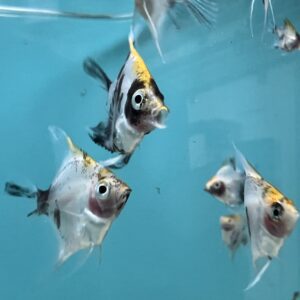
German Blue Ram (Mikrogeophagus ramirezi)
The German Blue Ram is one of the most beautiful dwarf cichlids in the hobby. Native to the Orinoco basin in Venezuela and Colombia, they’re a peaceful, intelligent fish that personalities seem too big for their three-inch bodies. They recognize their keepers, dance for food, and form genuine pair bonds. They’re also one of the more demanding species we stock, so this guide covers what we’ve learned keeping them at the shop and at home in Key West.
Quick Stats
- Scientific name: Mikrogeophagus ramirezi
- Adult size: 2 to 3 inches
- Minimum tank: 20 gallons for a pair, 30+ for a community
- Temperature: 78–84°F (warmer than most community fish)
- pH: 5.5–7.0, ideally below 6.5
- Hardness: Soft, 2–8 dGH
- Diet: Omnivore, leans carnivorous
- Temperament: Peaceful but territorial when breeding
- Lifespan: 2–4 years with good care
Tank setup
Rams are not nano fish even though they’re small. We recommend a 20-gallon long as an absolute minimum for a single pair, and 30 gallons or more if you’re keeping them in a community. The extra footprint matters more than the height because rams are bottom-to-mid water fish that need horizontal swimming and foraging space. Fine sand is the right substrate. They sift it through their gills the way the genus name Mikrogeophagus (small earth-eater) suggests, and gravel can damage their gill rakers. We use pool filter sand at the store.
Plant the tank heavily. Rams come from slow, tannin-stained streams shaded by overhanging vegetation, and bright open tanks stress them. Anubias, Cryptocoryne, Amazon swords, and floating plants like frogbit or red root floaters all work well. Add driftwood and a few smooth flat stones too. Flat stones are critical if you want them to spawn — rams are open substrate spawners that lay eggs on cleaned rock surfaces.
Filtration should be gentle. A sponge filter or a canister with the output baffled is ideal. Rams don’t tolerate strong current. Lighting should be subdued; floating plants help here. A tight lid is not strictly necessary because they don’t jump, but it does help hold heat and humidity, which matters because of the next point.
Water chemistry
This is where most ram keepers go wrong. German Blue Rams are warm-water fish. They want 80–84°F, not the 76–78°F that suits most community tanks. Lower temperatures suppress their immune systems and trigger disease, especially the protozoan infections rams are known for. If you can’t keep your tank at 80°F or above year-round, rams aren’t the right fish for that tank.
They also want soft, acidic water. Ideal pH is 5.5–6.5, and they’ll tolerate up to 7.0 if the change from your tap is gradual. Hardness should be low — 2 to 8 dGH. Hard, alkaline water shortens their lives and prevents successful breeding. Here in Key West our tap water comes off the Florida aquifer and is quite hard, so we cut it with RO water and a tannin source like Indian almond leaves or alder cones. If your tap is already soft and slightly acidic, you can probably just dechlorinate and go.
Stability is more important than chasing exact numbers. A stable pH of 7.0 is much better for rams than a pH of 6.5 that swings half a point between water changes. For more on this, see our Water Chemistry guide.
Diet
Rams are omnivores that lean carnivorous. They love small live and frozen foods — baby brine shrimp, daphnia, cyclops, frozen bloodworms, mysis. We feed our rams a rotation of two or three frozen foods plus a high-quality micro pellet (we use Bug Bites or Hikari Vibra Bites broken in half). Feed two small meals a day rather than one large one. Adult rams should fast one day a week. Watch their bellies; a healthy ram has a slightly rounded belly, not a sunken one and not a bloated one.
Tankmates
Rams are peaceful enough to keep with most small, calm community fish, but their warm water and soft-water requirements limit your options. Good tankmates include cardinal tetras, rummynose tetras, neon tetras, Corydoras (especially heat-tolerant species like sterbai or aeneus), small pencilfish, hatchetfish, and ottocinclus. Avoid anything nippy (tiger barbs, serpae tetras), anything cooler-water (white cloud mountain minnows, most platies), and anything large enough to bully them.
Two rams can be tricky. A bonded male-female pair is fine. Two males will fight, sometimes to the death in a small tank. Two females usually get along. If you don’t know what you have, three or four juveniles in a 30+ gallon tank will let them sort out a pair naturally, and you can rehome the extras.
Sexing and breeding
Males have a pointed dorsal fin with the first few rays extended into a long filament, a slimmer body, and brighter overall color. Females are smaller and rounder, with a noticeable pink or red belly that becomes very obvious when they’re full of eggs. Females also tend to have more blue iridescence in the black side spot.
If a bonded pair is healthy and well fed in clean, warm, soft water, they’ll spawn on their own. The pair will clean a flat rock or a broad leaf and lay 100 to 300 eggs. Both parents tend the eggs, fanning them with their pectoral fins and picking out infertile ones. Eggs hatch in 36 to 48 hours, and the wrigglers become free-swimming after another four or five days. First foods are baby brine shrimp or commercial fry food. Some first-time parents eat the eggs; this is normal and usually resolves by the second or third spawn. Don’t separate young pairs after a failed spawn; let them learn.
Common diseases
Rams are sensitive to nitrate, temperature swings, and shipping stress. The three illnesses we see most often are ich (white spot disease), hexamita (hole-in-the-head and stringy white feces), and bacterial fin rot. Ich responds to gradually raising temperature to 86°F and treating with a gentle ich med — but check the label, because rams are sensitive to copper. Hexamita is treated with metronidazole in food. Fin rot usually resolves with clean water and a partial salt treatment, but rams don’t love salt, so use the minimum effective dose.
The single most common cause of ram death we see is buying rams to put in an under-cycled tank. Rams need stable, mature water from day one. If your tank is less than two months old or your nitrate is above 20 ppm, wait before adding rams.
Ordering rams from us
We ship rams Monday and Tuesday only, and we hold orders if temperatures along the route are too cold or too hot. For full details, see our Shipping & Acclimation guide. Drip acclimate over 60 to 90 minutes — rams are more sensitive to pH and TDS swings than most fish their size.
Questions about whether rams are right for your setup? Email us at help@jojoaquatics.com before you order. We’d rather talk you out of a fish that won’t thrive than send one to a tank where it won’t survive.
— The JoJo Aquatics team, Key West, Florida
Frequently asked questions
What water parameters do German Blue rams need?
Warm, soft, acidic water: temperature 80-86F and pH 5.5-7.0. The warmth is not optional; rams kept too cool get stressed and prone to disease.
Are German Blue rams good for beginners?
They are a moderate-care dwarf cichlid. They are peaceful and beautiful but need a fully cycled, stable, warm tank, so they suit a careful keeper with an established setup.
What size tank do German Blue rams need?
A 20-gallon tank is a good minimum for a pair, with plenty of plants and gentle flow to give them territory and cover.
What fish live well with German Blue rams?
Peaceful, warm-water community fish like neon tetras and corydoras. Avoid fin-nippers and anything that competes aggressively for the bottom.
Can I keep two German Blue rams together?
A bonded male-female pair works well in a planted tank. Multiple males need space and sightline breaks to avoid squabbling over territory.